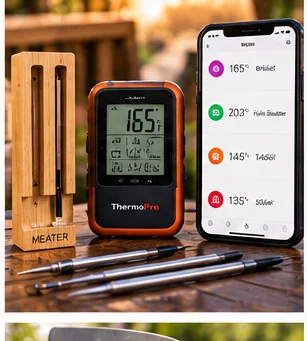
Products and configurations to compare
Thermapen ONE
One-second reading, IP67 body and AAA power.
Best when: you check many individual pieces
Watch for: not a leave-in probe
MEATER Pro Duo
Two Wi-Fi probes for ongoing monitoring.
Best when: you cook for hours and want remote alarms
Watch for: app/charging dependency
Fast budget instant-read
A fast inexpensive probe is better than guessing.
Best when: you need reliable temperature checks now
Watch for: quality and response time vary
Speed reduces lid-open time
Fast readings let you check several spots before the cooker loses substantial heat.
Leave-in monitoring reduces checking
You can follow the cook from the house instead of repeatedly lifting the lid.
Instant-read finds cold spots
Large cuts and chicken can vary across different areas.
Wireless monitoring improves scheduling
Alarms and trends help plan sides, rest time and serving.
The purchase order depends on food
Buy for the cooks you repeat rather than the most impressive spec sheet.
Instant-read and leave-in thermometers solve different problems
An instant-read thermometer gives a fast point measurement when you open the grill. It is ideal for steaks, burgers, chicken pieces, fish and final verification across a roast. A leave-in probe monitors the same piece over time, so it is better for brisket, pork shoulder and other long cooks. Serious grill setups benefit from both because speed at the end of a cook and trend data during a cook are different jobs.
Probe placement matters more than an app interface. Measure the thickest edible portion while avoiding bone, big fat seams and direct grate contact. With wireless multisensor probes, follow insertion-depth requirements so both the internal and ambient sensors sit where intended.
Safety temperature and preferred doneness are not the same thing
Current USDA guidance uses a food thermometer as the reliable way to verify safe endpoint temperatures. It lists 145°F plus a three-minute rest for whole cuts of beef, pork, lamb and veal, 160°F for ground meats, and 165°F for poultry. Personal preferences can be higher, while validated time-temperature methods are a separate advanced topic. The thermometer is there to replace visual guessing with a real measurement.
Before checkout
- Accessory physically fits the exact grill or cooking surface
- Heat rating exceeds the intended grill or sear temperature
- Thermometer type matches instant-read or leave-in use
- Fuel and storage gear protects against moisture
- Food-contact materials are appropriate and cleanable
- Grease and airflow paths remain unobstructed
- Handles and controls remain usable with grill gloves
- Outdoor storage can tolerate weather or comes inside
- Replacement probes, heads or parts remain available
- The purchase solves a repeated problem or adds a real cooking method
The accessory should earn its storage space
Outdoor cooking equipment multiplies quickly because each item looks inexpensive by itself. Picture where the product lives after the cook, when it is greasy, cold and wet. A rotisserie kit has a spit, motor and brackets. A cast-iron plate may weigh more than ten pounds. A thermometer is tiny and used constantly. Frequency of use should influence the budget as strongly as feature count.
Price the ownership layer too. Wireless probes need charging or replacement, steam-cleaning heads wear, pellet bins multiply by flavor and model-specific covers eventually weather. A good purchase still makes economic sense three seasons later.
First-cook test
Use new gear on a simple cook before a party. Verify thermometer connectivity, dry-fit rotisserie clearance, make sure grease can drain around a griddle, learn the pizza surface at your grill's actual temperature and confirm cleaning tools match the grate spacing. A ten-minute test can prevent a ruined meal or damaged accessory.
Afterward, decide whether the item changed capability, consistency or cleanup enough to keep. If it did not, use the return window rather than permanently adding it to the patio pile.
Frequently asked questions
Can Thermapen stay in the meat?
No.
Is Thermapen ONE accurate?
ThermoWorks currently specifies ±0.5°F through much of the cooking range.
Is wireless better for brisket?
For long monitoring, yes.
Which matters more for safety?
An accurate thermometer used correctly.
Current product/source checks
- ThermoWorks Thermapen ONE — current official specs
- MEATER Pro Duo — current official specs
- USDA/FSIS safe minimum internal temperature guidance
Affiliate disclosure: GrillGuide.co may earn from qualifying purchases through Amazon Associates and eBay Partner Network at no extra cost to you. Amazon links use scouttheory-20; eBay links use campaign 5339137014.